



2026 Regular Season
Midseason Report
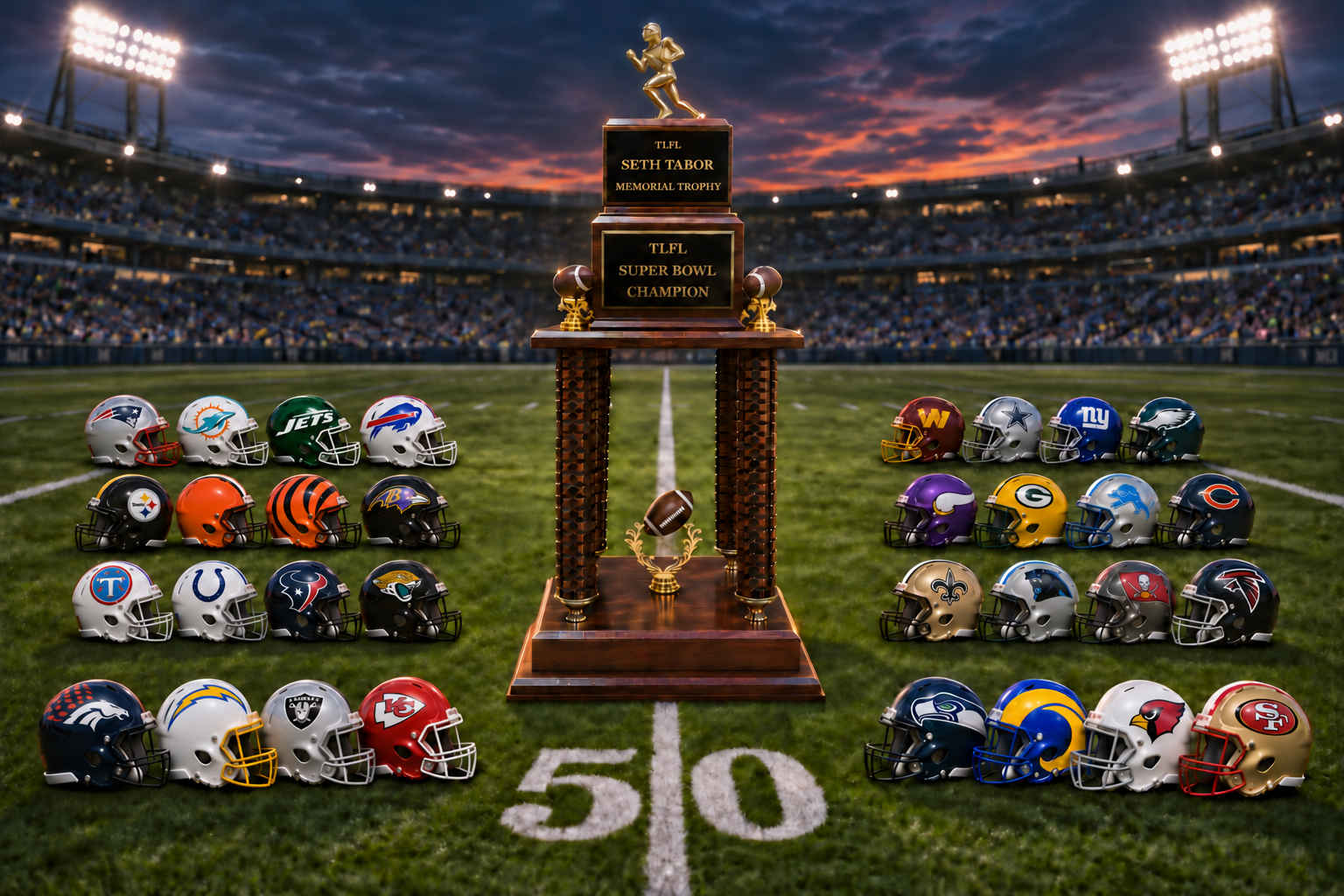
Seattle has become the team to catch, Buffalo has gone seven games without losing, and Detroit has discovered that a productive offense can eventually come with victories. At the halfway point of the schedule, the TLFL has crowded division races, expensive draft disappointments and late-round bargains changing the standings. Here is where all 32 teams stand, what their first halves tell us, and where the second half could take them.
AFC East
Buffalo Bills (6–1–1)
Buffalo has gone seven games without a loss, turning an opening defeat into the division's strongest record. Christian McCaffrey's 11.0 PPG and Ja'Marr Chase's 8.9 provide the foundation, while opponents averaging only 37.0 have helped keep Sundays manageable. Davante Adams' hamstring surgery has delayed the trade's payoff. The next two games, against the Jets and Dolphins, could reshape the race. Buffalo is my AFC champion: McCaffrey and Chase offer a formidable potential January core, and the Bills should be well placed to add help in the postseason draft.
New York Jets (6–3)
Jahmyr Gibbs' position-leading 15.2 PPG have given the Jets a major running-back advantage despite Terry McLaurin's season-ending knee injury. Consecutive wins have repaired a two-game slide and kept Buffalo within reach. Sam Darnold is currently out, adding another concern before the Bills visit. The Jets have enough scoring punch to trouble anyone in the AFC, but losing McLaurin has made them more dependent on Gibbs delivering every week. I expect a playoff berth; beating Buffalo would give New York a much better shot at something beyond a wild card.
Miami Dolphins (4–4)
Miami's 54.0-point average ranks second in the league, but opponents have answered with 52.1, leaving the Dolphins fighting for position in a crowded AFC East. Christian Watson's 9.9 PPG and Harold Fannin Jr.'s 5.5 have rewarded their first-round selections. Two Buffalo meetings make the road harder, although they also give Miami a chance to take points directly from the division leader. The Dolphins are my toughest AFC omission. Their offense belongs in the conversation, but too many productive Sundays have already ended without a win.
New England Patriots (3–6)
New England's 39.4-point average and consecutive losses have complicated its playoff hopes. After acquiring Josh Jacobs, Tucker Kraft and Keenan Allen from Tennessee, the Patriots moved Kraft and Allen to Dallas for Cade Otton and Cooper Kupp, with draft exchanges bringing back Dallas' 2027 first. That gives New England valuable future capital without stripping the offense bare. Jacobs is currently out, leaving an immediate hole in the backfield. A late run would be welcome, but the Patriots have given themselves something to build around even if January proves out of reach.
AFC North
Baltimore Ravens (4–4–1)
Baltimore followed three straight wins with a tie and a loss, leaving Cincinnati close behind at the midpoint. Bhayshul Tuten's 8.4 PPG and Isaiah Likely's 7.1 have rewarded their selections, while Lamar Jackson's thumb surgery and Michael Pittman's foot injury complicate the offense. The Ravens' 47.2-point average gives them the stronger body of work in a division that has offered little certainty. Baltimore is my AFC North pick, but getting healthy matters beyond that race. A wild-card meeting with the Jets would demand more than simply surviving the division.

Cincinnati Bengals (4–4)
Cincinnati has won consecutive games and just posted its season-best 60, keeping Baltimore within reach. The Bengals average 43.8 points, but injuries threaten to undo that progress. Jayden Reed's season-ending neck injury has undermined the receiving plan, while Rhamondre Stevenson's knee problem adds uncertainty in the backfield. The division is the clearest route to January, and Baltimore has left the door open. Cincinnati needs to turn its latest outburst into something dependable; asking a depleted offense to keep rescuing the season with occasional big weeks is a difficult bargain.
Cleveland Browns (3–6)
The Browns briefly found momentum with consecutive victories, then slipped back with a Week 9 loss. Their 34.6-point average is a larger concern than any single result, particularly against opponents averaging 50.2. The young receiving group has supplied little cushion: Rome Odunze averages 3.0 PPG; De'Zhaun Stribling's ankle surgery has made an already thin receiving corps even harder to rely on. Cleveland still has games available to change the picture, but the outlook requires a substantial scoring improvement. A few favorable matchups alone are unlikely to repair both the record and the production gap.

Pittsburgh Steelers (1–7)
Pittsburgh's 33.8-point average and one-win first half have made 2027 the priority. Trading George Pickens brought Antonio Williams and Kansas City's first-round pick in exchange for Pittsburgh's sixth. The latest move sends Kyler Murray and a fifth to New Orleans for Deshaun Watson and a third, adding another draft upgrade. Those deals give Pittsburgh more early-round resources for rebuilding the roster. The remaining schedule offers time to evaluate Williams, Blake Corum and other potential keepers before putting that improved draft capital to work.
AFC South
Jacksonville Jaguars (6–2)
Jacksonville has earned its place at the front of a competitive AFC South. The Jaguars average 52.8 points and have won their last two, with Jaxon Smith-Njigba's position-leading 11.9 PPG supplying the receiving production promised. Patrick Mahomes' elbow sprain and Garrett Wilson's concussion make health the immediate concern. Houston is close enough that the division remains unsettled, and their Week 15 meeting could matter considerably. Jacksonville is my choice to hold the South and contend for the conference, provided the offense avoids the occasional quiet week that already produced two losses.
Houston Texans (5–2–1)
Houston has built a strong first half around a productive backfield. James Cook's 11.9 PPG and Tony Pollard's 8.1 support a team averaging 52.4, almost level with Jacksonville. A loss followed by a tie has slowed the Texans without erasing their strong start. The receiving production remains less convincing; the Chris Godwin acquisition has not supplied a major scoring boost. The outlook is favorable for a playoff berth, with the division still within reach. A Week 15 home meeting with Jacksonville gives Houston a direct opportunity to change the South's order.
Indianapolis Colts (4–5)
Indianapolis has been competitive enough to remain interesting and inconsistent enough to remain below .500. The Colts have outscored opponents across the season, averaging 46.1 against 42.9, yet their record has not followed that positive margin. Brock Bowers and his fill-ins average a tight-end-leading 7.7 PPG. RJ Harvey's knee injury and move to injured reserve now put more pressure on that advantage. Indianapolis should stay involved in the wild-card discussion, but catching both Jacksonville and Houston will require a steadier second half than the first nine games delivered.
Tennessee Titans (1–7)
Four straight losses and a 35.0-point average have pushed Tennessee toward 2027. The New England deal brought back first- and second-round picks for fourth- and fifth-round selections in a package headlined by departing Josh Jacobs and Tucker Kraft. The subsequent Week 10 Justin Herbert trade adds another upgrade, exchanging Tennessee's sixth for Carolina's third alongside the switch to Cardinals QB. Jaylen Warren's 7.9 PPG remain useful, but the outlook centers on evaluating the remaining roster and converting that improved draft capital into a stronger team next season.
AFC West
Kansas City Chiefs (4–4)
Kansas City leads the AFC West despite a .500 record and a 42.6-point first-half average. Adding George Pickens gives the offense another threat, although his hamstring trouble could delay the payoff. Jadarian Price and his fill-ins have supplied only 2.0 PPG, leaving the Chiefs badly in need of more from the backfield. Las Vegas is my division choice, but Kansas City gets the final AFC wild card. The Pickens deal gives that bet some appeal; the Chiefs need him healthy enough to make their investment count down the stretch.
Las Vegas Raiders (4–5)
Kenneth Walker's 14.3 PPG have given Las Vegas a centerpiece, and his 25-point Week 9 helped end a three-game losing streak. The Raiders average 50.2 points but have allowed 50.0, leaving little separation in their results. Rico Dowdle adds another backfield option, while Terrance Ferguson's uncertain return complicates the tight end picture. Las Vegas is my AFC West pick and a dangerous wild-card opponent. Beyond that, a possible January roster overhaul makes the Raiders harder to trust than Buffalo or Jacksonville, especially with less favorable draft position.
Los Angeles Chargers (2–5–1)
The Chargers stopped a two-game losing streak with a tie against Houston, scoring 57 in their best result since the middle of the first half. Their broader problem remains a 44.0-point scoring average against 51.0 allowed. Denzel Boston averages 4.8 PPG and Sam LaPorta 4.9. A.J. Brown's ankle and knee trouble has removed a major receiving option. The outlook is still difficult, but Kansas City's modest lead keeps the division relevant. Los Angeles needs several productive weeks together; another isolated good performance will not do much to change its position.
Denver Broncos (1–8)
Denver's first win, 33–30 over Carolina after eight losses, featured 12 points from AJ Barner. The larger story is its investment in 2027 after a league-low 30.4-point average. Trades have brought in Baltimore's first-round pick and second-rounders from Houston, Washington and Las Vegas, with later selections going the other way. Xavier Worthy's hamstring injury complicates the remaining evaluation period. Denver can enjoy an upset while keeping its priorities clear: assess potential keepers, learn what the younger acquisitions offer and prepare to use a much stronger draft portfolio.
NFC East

Washington Commanders (5–3)
Three straight wins have given Washington the NFC East lead, with Derrick Henry's 11.0 PPG carrying considerable weight. The Commanders averaged only 39.9 points in the first half, nearly matching their opponents' 39.5, so this has hardly been a comfortable march to first place. Alec Pierce's heel injury leaves a receiving hole before the Giants visit. Dallas' additions keep the race competitive, but Henry gives Washington a player who can decide close games. I like the Commanders to win the East and get past New Orleans before Carolina ends their run.
Dallas Cowboys (5–4)
Dallas averaged 43.7 points through an uneven first nine games and has paid for more help. Tucker Kraft and Keenan Allen arrive from New England for Cade Otton and Cooper Kupp in a package that includes Dallas' 2027 first-round pick. That is a clear commitment to chasing the East now. D'Andre Swift's 9.9 PPG provide a foundation while David Montgomery manages a groin injury. The Cowboys sit just outside my playoff field, but Washington cannot afford to dismiss them. Dallas needs its new arrivals to turn promising weeks into wins quickly.
New York Giants (4–4)
The Giants reached three consecutive wins before Week 9 brought a season-low 21 and a return to .500. Parker Washington's 7.3 PPG have supported a respectable 45.0 team average, but Malik Willis' move to injured reserve with a groin injury changes the quarterback outlook. The schedule immediately offers a direct test against the division-leading Commanders. Continued contention looks more likely than an immediate breakthrough. The Giants have shown enough to make the division leaders uncomfortable, but they need more consistency before they can be trusted to take control of the East.
Philadelphia Eagles (4–5)
Philadelphia opened with two wins, then lost five of its next six before recovering in Week 9. The Eagles average only 37.2 points despite an offense stocked with the league's most recognizable names. Their opponents' 35.2 average has kept the overall margin positive and the record within reach of the division leaders. Travis Kelce averages 5.1 PPG, but Jalen Hurts' blood-clot-related absence and DeVonta Smith's hamstring injury have disrupted the offensive core. The outlook is a live division race with little room for complacency: Philadelphia can still change the order, but its early reputation cannot supply the missing points.
NFC North
Minnesota Vikings (4–3–1)
Minnesota leads the NFC North by winning percentage, but its recent scoring makes that perch feel considerably less secure than the standings suggest. The recent evidence is less cheerful: totals of 21 and 18 have produced consecutive losses after a three-game winning streak. De'Von Achane's season-ending ACL injury has weakened a backfield already struggling to sustain the offense. Minnesota averages 42.3 against opponents' 48.0. A Week 10 trip to Green Bay offers an immediate test. Retaining the division lead looks difficult unless Minnesota restores the scoring that produced their earlier wins before the chasing teams close in.
Green Bay Packers (4–4–1)
Green Bay followed a tie with a 60-point win over New England, reinforcing a first half that produced 51.6 PPG without a winning record. Jonathan Taylor's 8.7 PPG lead a group supported by Tetairoa McMillan and Chris Olave. Minnesota visits next, giving the Packers an immediate chance to press their case in the North. I expect Green Bay to win the division and a playoff game. A deeper run is tougher to envision if Taylor and McMillan are unavailable in January, particularly with Seattle waiting after the wild-card round.
Detroit Lions (3–5)
At 0–5, Detroit traded Davante Adams and a sixth-round pick for Kayshon Boutte and Buffalo's 2027 first with next season in mind. The Lions were selling veteran production to strengthen their draft position. Three straight wins have since changed the immediate picture, with Boutte scoring 19 in the latest victory. An unexpected playoff opportunity has emerged alongside the rebuilding plan. Detroit's 52.3-point first-half average gives the comeback some credibility, though the Lions have left themselves little room for another slump. Green Bay is my division pick, but Detroit can pursue contention with additional 2027 draft capital secured.
Chicago Bears (1–7–1)
Chicago has lost six straight since its only victory, averaging 35.6 points against opponents' 53.6. Its recent trades appropriately shift the focus toward 2027: the T.J. Hockenson deal upgraded a fourth-round pick to Buffalo's second, and the subsequent Carolina deal turned a fifth into a fourth. Luther Burden's 5.9 PPG offer promise, although his concussion interrupts that progress; Jordyn Tyson and his fill-ins average only 1.3. The remaining games are an opportunity to evaluate this young receiving group and potential keepers while the improved draft position provides a foundation for next season.
NFC South

New Orleans Saints (6–2)
New Orleans reached the midpoint averaging 52.8 points, with CeeDee Lamb contributing 10.4 PPG. With Kirk Cousins already in Minnesota, the Saints sent Deshaun Watson and a third-round pick to Pittsburgh for Vikings QB and a fifth in a push for the playoffs. Puka Nacua's return remains uncertain, and his absence leaves a substantial receiving hole. The Saints' strong start gives them a cushion, but I see a wild-card berth behind Carolina in a demanding NFC South.
Carolina Panthers (5–2–1)
Carolina's four-win opening has given way to one win, two losses and a tie, but the arrival of Justin Herbert gives the Panthers a timely boost before facing New Orleans. Bijan Robinson averages 10.4 PPG, while Jaylen Waddle's concussion leaves a concern at receiver. Carolina is my NFC South pick in a race that should stay tight. January could require substantial roster work, but a favorable draft position gives the Panthers a good chance to address their losses. I like them to reach the NFC Championship Game before running into Seattle.
Tampa Bay Buccaneers (6–3)
Tampa Bay returned to winning with a 47-point Week 9 after consecutive losses. Chuba Hubbard's 9.7 PPG have rewarded his second-round selection, while Jeremiyah Love's ankle injury has complicated a disappointing first-round return. The Buccaneers averaged 50.7 points in the first half, enough to make them a serious threat to either team above them in the South. Carolina is my narrow division choice, but Tampa Bay remains in my playoff field. Two remaining Saints meetings offer valuable opportunities to secure that place and keep pressing for the division.
Atlanta Falcons (4–5)
Atlanta has alternated losses and wins over its last five games, an efficient way to remain interesting without getting anywhere comfortable. The Falcons average 48.3 and allow 48.4, almost perfectly explaining their position near .500. Nico Collins and his fill-ins average 5.8 PPG; the Buffalo kicker contributes 10.0. Michael Wilson's season-ending neck injury further complicates chasing three division rivals with stronger records. The Falcons should remain competitive, but the playoff chase looks difficult. Atlanta needs to turn one of those productive afternoons into the start of a streak instead of another isolated win.
NFC West
Seattle Seahawks (8–1)
Seattle has eight wins, six straight victories and a league-leading 54.6 PPG. The 99-point Week 8 was spectacular, but the Seahawks have done enough around it to earn the NFC favorite's label. Mike Evans' Achilles problem and Ladd McConkey's back spasms test the receiving depth. Josh Allen and Tee Higgins could anchor a strong January roster, with an early draft position offering room to strengthen it further. Seattle is my pick for the conference's top seed and to beat Buffalo in Super Bowl XXXI. Health is the biggest threat to that finish.

Los Angeles Rams (6–3)
The Rams began 4–0, then went 2–3 across their next five games, including a season-low 32 in Week 9. Kyren Williams averages 8.2 PPG, while opponents' league-low 33.3-point average has helped preserve a useful record. That cushion matters, but Los Angeles cannot count on such forgiving Sundays all season. Seattle looks difficult to catch, leaving the Rams to protect their place in the wild-card chase. I expect them to get in, although their 44.4-point offense needs a stronger finish to make Carolina uncomfortable in an opening-round matchup.
Arizona Cardinals (5–4)
Arizona's four-game winning streak has given way to consecutive losses, leaving a team with division ambitions well behind Seattle. Bucky Irving's 9.6 PPG and Trey McBride's 6.4 have supplied the strongest offensive returns, while a 46.2 team average keeps the Cardinals competitive without placing them among the league's leading scorers. The Rams visit next, offering a useful chance to repair both the record and divisional position. A crowded wild-card chase leaves little margin for another extended slide. Arizona can still reach January, but the Cardinals have made their road much harder over the last two weeks.
San Francisco 49ers (4–4)
San Francisco has four wins and enough competitive afternoons to keep a playoff berth within sight. That is meaningful progress, although a 43.0-point average and 42.4 allowed describe a team living close to its opponents. The latest setback was a three-point loss to Las Vegas despite a season-best 10 from first-round receiver KC Concepcion. San Francisco should stay in the wild-card discussion, but falls outside my predicted field. The 49ers have kept themselves in the race; the next challenge is finding enough consistent production to move beyond alternating competitive wins and frustrating losses.
Best and worst draft picks
Best values
1. Isaiah Likely NYG
At 7.1 PPG, Likely has outscored first-round picks Travis Kelce and George Kittle from the second round. Baltimore gets an immediate edge at tight end and a young player worth considering for its keeper core.
2. Christian Watson GB
Miami spent the ninth pick on Watson and got the league's third-highest-scoring receiver by PPG. His 9.9 PPG have made him one of the driving forces behind the Dolphins' high-scoring first half.
3. Chuba Hubbard CAR
Tampa Bay found a top-10 running back at No. 34. Hubbard's 9.7 PPG have helped hold the offense together through Jeremiyah Love's disappointing start.
4. Mike Gesicki CIN
Jacksonville waited until pick 159 and still landed TE5 production at 5.8 PPG. Getting that kind of return in the fifth round has been a quiet advantage in a tight division race.
5. New York Jets kicker NYJ
Seattle took the 29th kicker off the board and got K11 production at 8.4 PPG, a useful weekly edge from a sixth-round selection.
Worst values
1. Michael Pittman Jr. PIT
A foot injury has derailed Baltimore's investment in Pittman at No. 14. He and his fill-ins have managed just 0.6 PPG, leaving the Ravens with almost nothing from a pick that needed to anchor their receiving group.
2. Jadarian Price SEA
Price's developmental upside still matters, but he and his fill-ins have averaged just 2.0 PPG after Kansas City used the second overall pick on him. Bhayshul Tuten went next and has delivered 8.4 PPG, making the slow start harder to stomach.
3. Mark Andrews BAL
Andrews' 1.3 PPG have been a poor return on Buffalo's second-round investment. Mike Gesicki went 99 picks later and has supplied 5.8 PPG, a painful comparison for a team that paid for an established name.
4. Quentin Johnston LAC
Houston has received just 1.9 PPG from the twelfth pick. Christian Watson went three selections earlier and has produced 9.9 PPG, leaving Johnston well short of the return the Texans needed at that price.
5. Keenan Allen SF
Allen and his fill-ins have averaged 2.3 PPG, offering little immediate help from the 61st pick. Tennessee paid for a veteran it could count on, and the weekly production has not justified that second-round cost.
All-TLFL Team
All Bust Team
Road to Super Bowl XXXI
BillsBUFFirst-round byeBye
RavensBALJetsNYJJaguarsJAXChiefsKCRaidersLVTexansHOUBillsBUFJetsNYJJaguarsJAXRaidersLVBillsBUFJaguarsJAXSeahawksSEAFirst-round byeBye
PackersGBBuccaneersTBPanthersCARRamsLARCommandersWSHSaintsNOSeahawksSEAPackersGBPanthersCARCommandersWSHSeahawksSEAPanthersCARSeahawksSEABillsBUFSeattle Seahawks
Seattle over Buffalo is my pick for Super Bowl XXXI. Josh Allen gives the Seahawks a potential January centerpiece, and an early draft position should help them build around whoever survives from a receiving group led by Tee Higgins and Mike Evans. Buffalo has an equally compelling path behind Christian McCaffrey and Ja'Marr Chase, with first choice of the draft's available talent. Jacksonville's draft position gives it the edge over a Las Vegas team that could face a much larger rebuild. Carolina can work its way to the NFC title game, but Seattle's combination of star power and opportunities to add talent gets my vote to lift the Tabor Trophy.